

1. Market Context and Business Framework (Executive Summary)
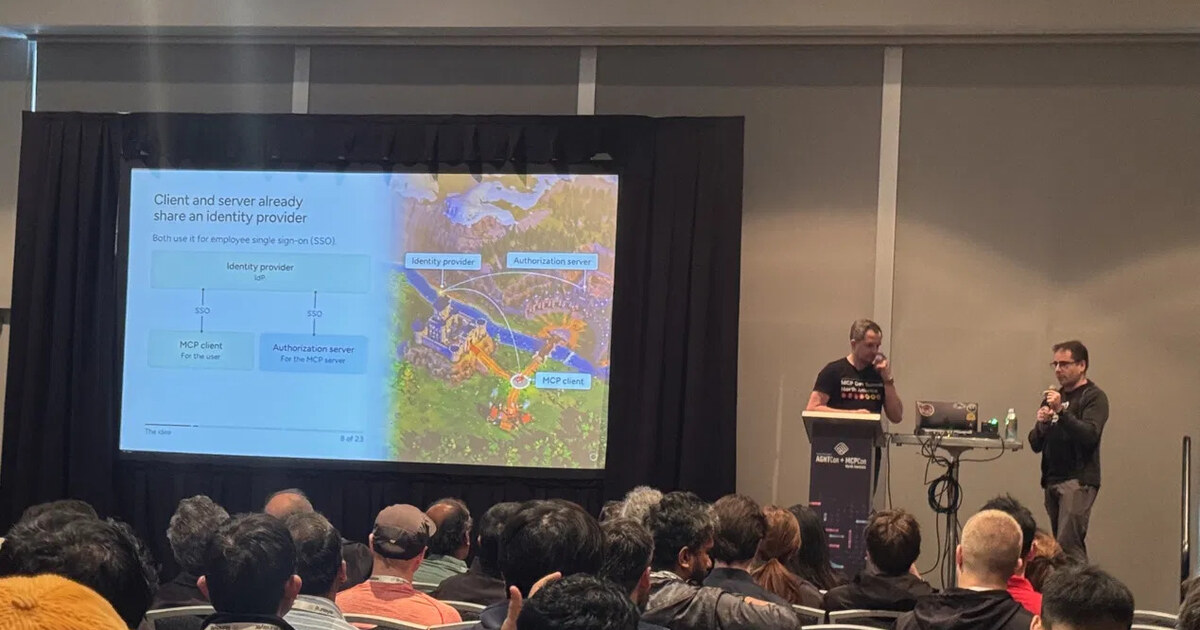
October 2026 delivered decisive signals from AGNTCon + MCPCon North America 2026 – two of the most consequential events shaping the trajectory of agentic artificial intelligence in production enterprise environments. The Agentic AI Foundation announced four new projects: OpenSandbox, Open Responses, Agent Skills, and OpenEnv, bringing its total active initiatives to ten just one year after its founding. Representatives from Anthropic, OpenAI, Google, and UC Berkeley took the stage, with discussions dominated by three critical themes: MCP in production, agent security, and the emerging concept of autonomous agent identity.
For boards of directors, CTOs, and business owners across manufacturing, trade, and services, these events carry one fundamental message: agentic AI has graduated from laboratory experimentation to a legitimate business tool capable of generating measurable value – provided the deployment follows proven engineering principles.
Traditional automation approaches – sequential scripts, rigid RPA integrations, monolithic workflow engines – falter against the dynamic realities of modern operations: variable data formats, unpredictable process exceptions, and an ever-growing number of systems requiring coordination. Agentic AI, built on the Model Context Protocol (MCP), offers flexible, context-aware task orchestration that adaptively responds to changing conditions – without requiring code rewrites every time a business process changes.
The strategic implications for C-suite leaders are unambiguous: organizations that fail to define their AI agent deployment strategy within the next 12–18 months risk widening the competitive capability gap against rivals already deploying agents to automate invoicing, claims processing, inventory monitoring, risk analysis, and customer communications.
2. Deep Technical Analysis and Risk Vectors
The Model Context Protocol (MCP), originally designed by Anthropic as an open standard for communication between large language models (LLMs) and external tools, has evolved into a full-fledged orchestration bus for autonomous agents. Its architecture rests on three layers:
- Tool Layer: Standardized interfaces enabling an agent to invoke external functions – APIs, databases, ERP systems, files, and web browsers.
- Context Layer: Mechanisms for passing session state, action history, and system instructions between steps of an agentic reasoning chain.
- Identity Layer: A critical new component discussed extensively at MCPCon 2026 – each agent receives a cryptographically verifiable identifier, enabling audit trails, permission scoping, and accountability for actions taken.
From an engineering perspective, deploying AI agents in production reveals several serious risk vectors that every CTO must address in solution architecture:
Security Risk: Prompt Injection and Privilege Escalation
AI agents operating on external data are vulnerable to prompt injection attacks – malicious instructions embedded in processed documents can reprogram agent behavior, leading to unauthorized data access, destructive operations, or leakage of confidential information. This is particularly dangerous for agents with access to ERP systems, customer databases, or financial data.
Data Integrity Risk: Non-Determinism and Hallucinations in Transactional Processes
Language models are inherently non-deterministic – the same input sequence can generate different outputs. In processes requiring ACID consistency (e.g., writing an invoice to a tax authority system, updating inventory levels, recording cash transactions), agent non-determinism without proper guardrails can lead to duplicates, missing transactions, or erroneous records.
Operational Risk: Uncontrolled Agent Loops and API Cost Explosions
Agents operating in ReAct (Reason + Act) loops without configured limits can enter infinite reasoning cycles, generating explosive API call costs (OpenAI, Anthropic, Google) and blocking compute resources. Without token monitoring and circuit-breaker mechanisms, a monthly API bill can exceed budget within hours.
Compliance Risk: GDPR and Personal Data Processing by Agents
An AI agent processing documents, emails, or customer data may inadvertently violate GDPR regulations if personal data is transmitted to external cloud models without appropriate data processing agreements. GDPR penalties for violations can reach 4% of global annual turnover.
3. Solution Architecture and Step-by-Step Deployment Guide
Drawing on over 23 years of deploying IT systems for enterprises, AbejaIT has developed a production-grade reference architecture for AI agents that minimizes the described risks while ensuring scalability from pilot to full deployment.
Step 1: Isolation Sandbox (OpenSandbox Pattern)
Every agent runs in an isolated container environment, separated from the production network. The OpenSandbox pattern – one of the Agentic AI Foundation's new projects – defines isolation standards: no internet access, restricted filesystem permissions, execution time limits.
# Docker Compose for isolated AI agent
version: '3.9'
services:
  ai-agent:
    image: abejait/mcp-agent:1.4.2
    environment:
      - MCP_ENDPOINT=https://internal-mcp.abejait.local
      - MAX_TOKENS=8192
      - AGENT_TIMEOUT=120
      - GDPR_MODE=strict
    networks:
      - agent-sandbox
    read_only: true
    security_opt:
      - no-new-privileges:true
    mem_limit: 2g
    cpus: '1.5'

networks:
  agent-sandbox:
    driver: bridge
    internal: true  # No internet access
Step 2: MCP Server with Context Validation
The central MCP server acts as a context gateway – verifying agent permissions before every tool call, logging all operations, and enforcing security policies:
# MCP Server configuration with audit logging
mcp_server:
  host: 0.0.0.0
  port: 8443
  tls: true
  cert_path: /etc/ssl/mcp/server.crt
  key_path: /etc/ssl/mcp/server.key
  audit_log: /var/log/mcp/audit.jsonl
  tools:
    - name: query_erp
      allowed_agents: [invoice-agent, stock-agent]
      rate_limit: 100/minute
      pii_filter: true
    - name: send_email
      allowed_agents: [crm-agent]
      require_human_approval: true
  identity:
    jwt_secret: ${MCP_JWT_SECRET}
    token_ttl: 3600
Step 3: Backup and Disaster Recovery for Agent Data
Agent states, conversation histories, and audit logs must be covered by the 3-2-1 backup rule: 3 copies, 2 different media, 1 offsite copy. We recommend PostgreSQL with WAL archiving to S3-compatible storage:
# pg_basebackup + WAL streaming to MinIO (S3-compatible, on-premise)
pg_basebackup \
  -h localhost \
  -U replicator \
  -D /backup/pg_base_$(date +%Y%m%d) \
  -Ft -z -P --wal-method=stream

# Backup verification (DR test every 30 days):
pg_restore --list /backup/pg_base_20261015/base.tar.gz | head -20
Step 4: Real-Time Agent Monitoring
Integration with Prometheus + Grafana for agentic metrics: tokens per call, response time, error rate, API costs. Alert on threshold breach:
# Prometheus alert rule for agent cost overrun
groups:
  - name: ai_agent_alerts
    rules:
      - alert: AgentTokenBudgetExceeded
        expr: sum(ai_agent_tokens_used_total) > 1000000
        for: 5m
        labels:
          severity: critical
        annotations:
          summary: "Agent exceeded monthly token budget"
          description: "API cost may exceed planned budget. Immediate intervention required."
4. Engineering Deployment and Audit Checklist
- Environment isolation: Each agent runs in a separate Docker/Podman container with
internal: truenetwork – no unauthorized internet access. - Agent identity management: Each agent has a unique JWT/API Key with limited TTL (max 1h) and scoped permissions (principle of least privilege).
- Input sanitization: All external data (documents, emails, API responses) passes through a PII filter and anti-injection layer before reaching the model.
- Token limits and circuit-breaker: Hard token limits configured per session (max_tokens), circuit-breaker mechanism interrupts agent loop after N failed attempts.
- Full audit log: Every MCP tool call logged to an immutable, append-only (WORM) log with timestamp, agent ID, and operation result.
- Prompt injection penetration testing: Before production deployment – minimum 50 prompt injection attack scenarios, including multilingual and PDF/DOCX-embedded variants.
- GDPR policy for agent-processed data: Data classification (public/sensitive/personal), data processing agreements with LLM provider, or private on-premise model instance.
- 3-2-1 backup of agent states and logs: Automated backup of state database every 6 hours, DR restoration test every 30 days with documented RTO/RPO.
- Human-in-the-Loop for critical operations: High-risk operations (payments, document dispatch, database modifications) require human approval – configured in MCP Server policy.
- Real-time API cost monitoring: Grafana dashboard with
tokens_used_totalandapi_cost_usdmetrics, alerts at 80%/95% of monthly token budget with automatic throttling. - Model and security policy updates: Monthly scheduled reviews of LLM model version, system prompt updates, and guardrails in line with provider changelogs.
- Documentation and SLA: Documented agent architecture, defined availability SLA (minimum 99.5%), escalation procedures for failures.
5. Legal, Tax, and Regulatory Compliance Requirements
Deploying AI agents in a European enterprise is subject to several parallel regulatory regimes. Ignoring them carries serious legal and financial consequences.
NIS2 Directive and National Cybersecurity Legislation
The NIS2 directive has dramatically expanded the scope of cybersecurity obligations, bringing many SME-sized operators under its remit. Agentic systems, as elements of critical IT infrastructure, must comply with requirements for risk management, incident reporting (24h/72h timelines), and security audits. Penalties reach €10 million or 2% of global turnover for "important entities."
GDPR and Personal Data Processing by AI Models
Every AI agent processing personal data (names, addresses, document numbers, customer financial data) must operate on a clear legal basis for processing (Art. 6 GDPR). Key requirements:
- Data Processing Agreement (DPA) with the API provider (OpenAI, Anthropic, Google) or deployment of a private on-premise model instance (Llama, Mistral, or fine-tuned models).
- DPIA (Data Protection Impact Assessment) for agentic systems processing personal data at scale.
- Implementation of the right to erasure and the right to object to automated processing (Art. 22 GDPR).
EU AI Act
The EU AI Act classifies AI systems by risk level. AI agents operating in business processes (recruitment, credit scoring, automated decisions) may be classified as High-Risk AI Systems, requiring:
- Registration in the EU database of high-risk AI systems.
- Maintenance of technical documentation and logs for a minimum of 10 years.
- Implementation of human oversight mechanisms.
- Bias testing of training data.
E-Invoicing and AI Agents in Financial Workflows
AI agents assisting in invoicing processes must be integrated with applicable national e-invoicing systems (such as Poland's KSeF, or EU's equivalent mandates). Incorrectly generated invoices submitted by an agent carry the same tax penalties as manually issued ones – legal responsibility rests with the business, not the AI system. This makes robust validation guardrails non-negotiable.
6. Total Cost of Ownership (TCO) vs Return on Investment (ROI)
The decision to deploy AI agents must be grounded in rigorous economic analysis, accounting for both deployment costs and measurable operational savings.
Typical Deployment Costs for an Agentic AI System (SME Scale)
- Server infrastructure: Dedicated GPU server (NVIDIA RTX 4090 or A10G) for private on-premise models: €3,500–€9,500 one-time, or €450–€1,200/month for cloud GPU instances (AWS/GCP).
- API costs (cloud models): For 50 agents processing an average of 100 documents daily – estimated €700–€1,900/month (GPT-4o, Claude 3.5 Sonnet) with token optimization.
- Implementation and integrations: Pilot project (3 processes, 8 weeks): €6,000–€14,000. Full enterprise deployment: €19,000–€60,000.
- Monitoring and maintenance: €450–€1,200/month (SLA 99.9%, 24/7 monitoring, security updates).
Measurable Benefits and ROI
- Invoice processing automation: Time reduction from 8 minutes (manual) to 45 seconds (AI agent) – at 500 invoices/month: savings of 58 person-hours = approximately €1,100/month at €19/h.
- Elimination of manual errors: Average cost of a financial document error (VAT correction, credit note, penalties) estimated at €50–€120/error. 90% error reduction on 50 monthly errors = €2,250–€5,400/month savings.
- Accelerated customer service: A CRM agent handling customer inquiries 24/7 eliminates the need for an additional night-shift hire: savings of €950–€1,700/month.
- Avoiding regulatory penalties: Automated compliance verification of documents can prevent penalties of €2,500–€25,000+ per incident.
Estimated ROI break-even: 6–14 months for a typical agentic AI project in an SME, with well-designed architecture and correct process selection for automation.
7. Frequently Asked Questions (FAQ)
Do I need to use cloud AI models (OpenAI, Anthropic), or can I run a model locally?
Both approaches are viable and justified in different scenarios. Cloud models (GPT-4o, Claude 3.5 Sonnet, Gemini 1.5 Pro) offer the highest reasoning quality and are ready to use without hardware investment, but they involve transmitting data to external providers – requiring data processing agreements and potentially being problematic for sensitive data. Local models (Llama 3.1, Mistral Large, Qwen 2.5) run on your own GPU server and provide full data control while eliminating recurring API costs, but require infrastructure investment (minimum NVIDIA RTX 4090 or A10G server) and DevOps competency. AbejaIT recommends a hybrid architecture: public and non-classified data processed via cloud API, personal and sensitive data via private on-premise instance.
How does an AI agent differ from a traditional RPA bot, and when should I choose each?
An RPA (Robotic Process Automation) bot executes predefined, deterministic step sequences on a graphical interface or via API – fast and reliable, but brittle: any change in screen layout or data format requires reprogramming. An AI agent can adapt to variable data, understand context, handle exceptions, and make decisions based on reasoning – but is non-deterministic and requires guardrails. Practical rule: RPA for 100% structured processes with zero error tolerance (e.g., writing to a government registry); AI agent for processes with high input variability (e.g., analyzing customer emails, extracting data from heterogeneous PDF documents, coordinating multi-step workflows).
How do I ensure an AI agent doesn't violate GDPR when processing customer documents?
Key technical and organizational measures: (1) Implement a PII (Personally Identifiable Information) filter before every LLM call – libraries like Microsoft Presidio or dedicated NER models detect and anonymize personal data before transmission to the model. (2) For data that cannot be anonymized – use a private on-premise model instance with no external API transmission. (3) Execute a Data Processing Agreement (DPA) with your API provider per Art. 28 GDPR, verify the provider's SOC 2 Type II and ISO 27001 certifications. (4) Configure opt-out from model training on company data (OpenAI Enterprise, Anthropic Claude for Enterprise offer such guarantees). (5) Maintain a Record of Processing Activities (RoPA) that includes agentic systems as separate processing operations.
How do I monitor AI agent costs and prevent uncontrolled API spending?
A multi-layered cost control approach: (1) API budgets at project level – all major providers (OpenAI, Anthropic, Google) offer hard spending limits, after which the API returns an error instead of incurring further charges. (2) Token budgeting in agent code – every LLM call includes a max_tokens parameter set to what the task actually requires (not the model's global maximum). (3) Response caching – for repetitive queries (e.g., analyzing the same document templates), semantic caching (Redis + embeddings) reduces API costs by 40–70%. (4) Right model for the right task – not every operation requires GPT-4o; document classification, data extraction, and simple responses can be handled by smaller, cheaper models (GPT-4o-mini, Claude Haiku). (5) Grafana dashboard with tokens_used_total and api_cost_usd metrics, alerts at 80%/95% of monthly budget.
8. Dedicated Solutions and Deployment in the AbejaIT Ecosystem
Since 2003, AbejaIT has been building software for enterprises across Poland – and we are among the first in our niches to integrate proven agentic AI solutions with existing industry-specific systems. Our approach combines deep domain knowledge with current engineering practice.
For scrap metal and raw material procurement businesses, the ESSW system (zlom.io) offers ready-made integrations with vehicle weighbridges, waste management registries, and cash settlement systems. Our AI solutions can automate material classification from photographs, supplier document verification, and regulatory reporting.
For coal and solid fuel depots, the wegiel.io platform handles excise goods records and statutory compliance documentation. AI agents can support automatic completeness verification of declarations and excise report generation.
For manufacturing, trading, and service companies, the mojafirma.io ERP system with full e-invoicing integration provides the natural platform for deploying invoicing agents, income document classification, and automatic VAT whitelist verification – fully automated, without human involvement in routine documents.
Allotment garden (ROD) managers will find dedicated support in the dzialkowiec.io system, where AI can automate fee calculation, utility consumption analysis, and resident communications through the gardener portal.
If you need secure server infrastructure for AI agents – high-availability clusters, private GPU model instances, 24/7 monitoring – explore our IT infrastructure services and 24/7 server monitoring.
Our AI agent and artificial intelligence deployments cover the complete lifecycle: from process audit and model selection, through MCP architecture design, production deployment in isolated environments, to API cost monitoring and optimization. Every deployment is documented for GDPR, NIS2, and EU AI Act compliance.
Want to find out which processes in your organization will deliver the fastest ROI from agentic AI? Schedule a free technical consultation with our engineers: contact the AbejaIT team.
Source reference: InfoQ