

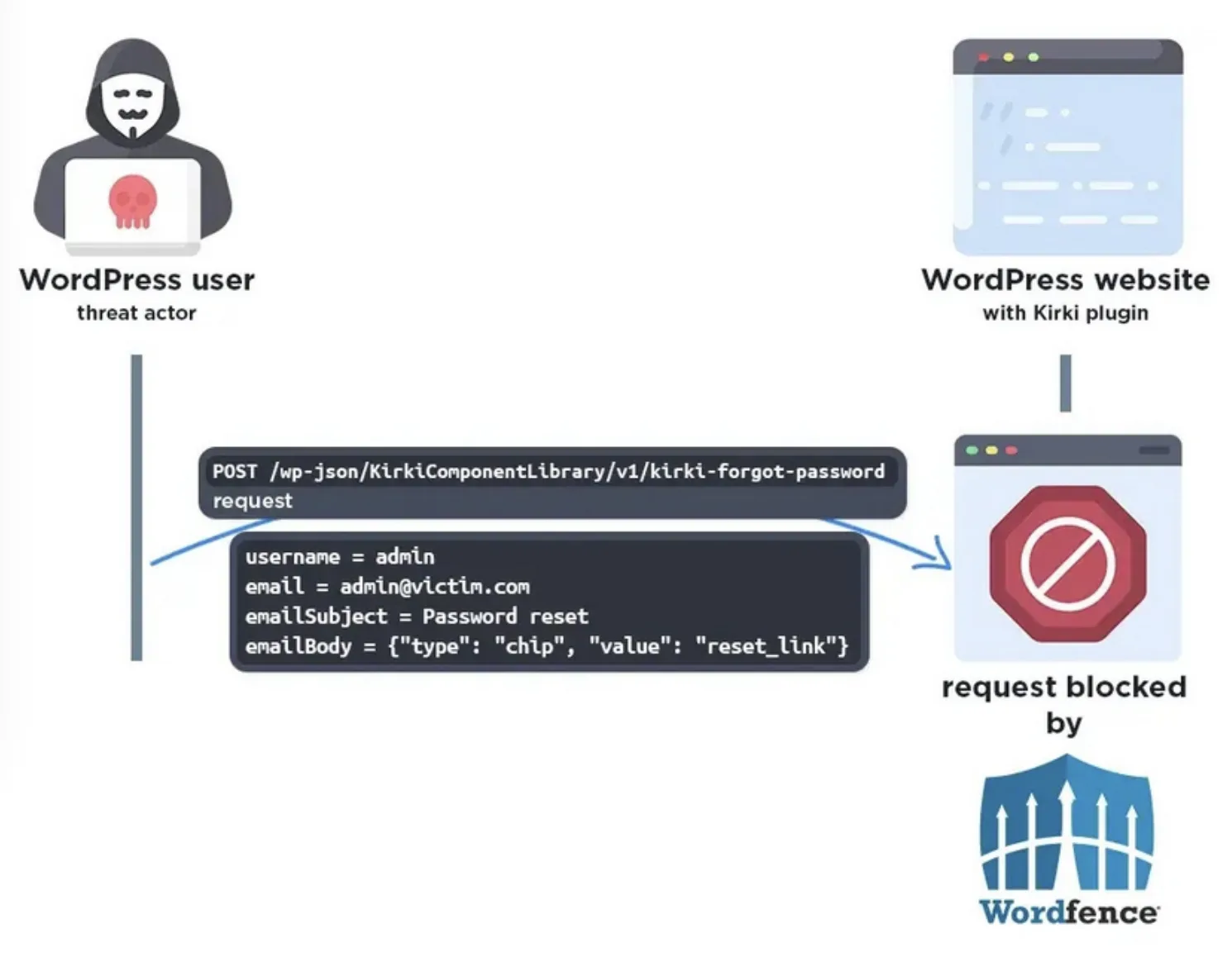
Security researchers identified critical vulnerability CVE-2026-8206 in the popular Kirki WordPress plugin. The flaw enables an unauthorized attacker to take over an administrator account without knowing the password. Kirki is installed on hundreds of thousands of sites as a theme options framework—making the potential threat scale significant.
Exploit Mechanism and Threat Scale
The vulnerability stems from improper input validation in the plugin's settings update mechanism. Attackers can send a crafted HTTP request that modifies administrator account data—including the email address linked to the account—enabling password reset and full WordPress panel takeover.
For B2B companies maintaining corporate websites, industry blogs, or landing pages on WordPress, admin account takeover means the ability to inject malicious code, steal contact form data, deface the site, or use the server for further attacks. A corporate website is often the client's first point of contact—its compromise destroys trust and may violate GDPR.
Why WordPress Plugins Are Persistent Risk
- Distributed ecosystem – thousands of plugins from independent developers with varying code quality.
- Delayed updates – many installations run outdated versions for months.
- Automated exploits – botnet scanners mass-search for known CVEs on publicly accessible sites.
- Dependency chain – one vulnerable plugin compromises the entire CMS installation.
Immediate Steps for Administrators
If you use the Kirki plugin, update to the latest patched version or temporarily deactivate until security is confirmed. Check admin panel access logs for unusual logins and user account setting changes. If compromise is suspected, perform full file analysis, reset all admin account passwords, and consider rotating API keys and integration tokens.
Organizations should implement plugin management policy: whitelist of allowed extensions, regular version audits, automatic CVE notifications, and update testing on staging before production. For critical corporate sites, consider a WAF (Web Application Firewall) filtering known WordPress attack patterns.
Architectural Alternatives for B2B Companies
Companies for whom the website is a key sales or communication channel should assess whether WordPress with many plugins is the optimal long-term choice. Custom software or headless CMS with a separated presentation layer offers better security control, code auditability, and CI/CD with security testing.
If WordPress remains in the tech stack, minimize plugin count, apply hardening (disable file editor, restrict REST API, MFA on admin accounts), regular backups, and file integrity monitoring. Outsourcing site maintenance to a partner offering IT infrastructure services transfers patch management responsibility to a team with dedicated procedures.
Long-Term Web Security Strategy
CVE-2026-8206 is another entry on the long list of WordPress ecosystem vulnerabilities. B2B organizations should not treat each incident as an isolated event—but as a signal for systematic web architecture review. Inventory of all websites and web applications, mapping dependencies on plugins and libraries, and modernization plans reduce attack surface over years.
Training marketing and content teams on secure CMS panel use, limiting admin account count, and using editorial accounts with minimal permissions are simple measures with high effectiveness. Combined with technical safeguards, they create defense in depth that limits impact even when the next zero-day appears in a popular plugin.
Vulnerability Management in the CMS Ecosystem
Organizations maintaining multiple WordPress sites should centralize update management through tools like WP-CLI, ManageWP, or dedicated vulnerability monitoring platforms. Automatic scanning of installations for known CVEs, combined with alerts from NVD and WPScan databases, shortens response time from days to hours.
In CI/CD for corporate sites, add dependency scanning (SCA) and DAST testing before production deployment. Even if the marketing team manages content, technical security responsibility should rest with IT. Clear role division—who updates plugins, who approves changes, who responds to CVE alerts—eliminates situations where a critical vulnerability remains unpatched because "nobody knew it was their responsibility."
Website Security as B2B Brand Element
Corporate website defacement or malware injection into a contact form is an incident B2B clients remember long after technical repair. In regulated industries—finance, healthcare, manufacturing—external auditors increasingly ask about public website vulnerability management as part of vendor due diligence.
We recommend quarterly review of all organizational web assets: domains, subdomains, marketing campaign landing pages, and publicly accessible staging environments. A forgotten WordPress installation on a test subdomain is a classic attack vector bypassing production security and often remaining off IT radar.
CMS Vulnerability Response Plan
Every organization maintaining WordPress should have a documented critical CVE response plan: who decides to disable a plugin, who communicates with marketing, and how quickly patches deploy to staging and production. Without such a plan, the exposure window extends from hours to days—exactly what botnets need for mass exploitation of newly published vulnerabilities.
Source: Sekurak