

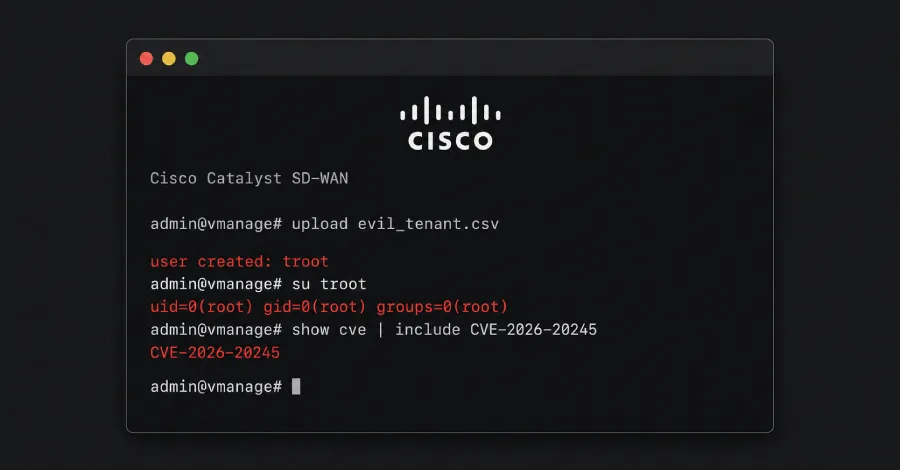
Cisco confirmed active exploitation of vulnerability CVE-2026-20245 in Cisco Catalyst SD-WAN—a flaw rated CVSS 7.8 allowing a local authenticated user to escalate privileges to root and execute arbitrary system commands. Attackers exploited the flaw for at least two months before official disclosure and patch release. For B2B companies using Cisco SD-WAN to connect branches, data centers, and cloud, this incident directly impacts operational continuity and WAN security.
SD-WAN as Critical Infrastructure
SD-WAN (Software-Defined Wide Area Network) centralizes routing, security policy, and QoS management across multiple locations. Compromising an SD-WAN controller gives attackers visibility and control over traffic between all connected sites—equivalent to taking over the corporate network core. Root escalation on SD-WAN devices enables backdoor installation, firewall rule modification, VPN traffic interception, and lateral movement to segments that should be isolated.
Organizations often treat network devices as "set and forget"—firmware updates are deferred fearing connectivity disruption. Two months of active exploitation before disclosure shows attackers monitor such flaws and exploit the window before vendors publish advisories.
Immediate Remediation Steps
- Patch – apply Cisco advisory patch in a maintenance window with rollback plan.
- Inventory – identify all Catalyst SD-WAN deployments and software versions.
- Threat hunting – search for unusual local accounts, cron jobs, and configuration changes.
- Segmentation – restrict SD-WAN admin access only from jump hosts.
Zero-Day and Vulnerability Management Process
CVE-2026-20245 illustrates limitations of traditional vulnerability management based solely on CVE feeds—the flaw was exploited before entering public databases. Organizations should supplement patch management with network device threat hunting, configuration anomaly monitoring (e.g., Cisco IOS XE integrity verification), and vendor early notification program participation.
For companies without dedicated network security teams, outsourcing IT infrastructure with SLAs for critical CVE remediation on edge devices can reduce exposure windows from weeks to hours.
Impact on Multi-Site Architecture
Companies with branches in multiple cities or countries often rely on SD-WAN for consistent security policies. Central manager compromise means attackers can distribute malicious rules to all edge devices simultaneously. Post-remediation, conduct full configuration audit—compare running-config with golden template and verify VPN certificates.
SD-WAN configuration backups should be stored offline and integrity-verified before restore. Disaster recovery procedures must account for controller compromise scenarios, not just hardware failure.
Lessons for CISOs
CISOs should report to the board not just unpatched CVE counts but exposure time to known actively exploited vulnerabilities. Two months of pre-disclosure exploitation argues for network detection investment on managed devices and regular red team exercises covering WAN infrastructure.
NIS2-covered organizations with critical infrastructure must document remediation within regulatory deadlines—delayed SD-WAN patching may result in administrative sanctions regardless of actual incident occurrence.
Business Communication During SD-WAN Remediation
SD-WAN patching often requires maintenance windows affecting branch connectivity. IT directors should prepare business communication plans: alternative paths (backup LTE, split tunnel), minimal traffic hours, and rollback procedures. Transparency with end users reduces pressure to defer patches "until next quarter"—a pattern that in CVE-2026-20245's case meant two months of exposure.
Managed SD-WAN SLA contracts should specify maximum critical CVE remediation time (e.g., 72h from advisory)—transferring operational responsibility to partners with clear consequences.
Vendor Risk Management for Cisco
Organizations should integrate Cisco PSIRT advisories into vendor risk management with automatic ITSM tickets upon CVE publication affecting deployed products. Cisco API integration with ServiceNow or Jira shortens time between advisory and remediation owner assignment. Cisco Smart Net Total Care or GOLD partner contracts provide early notification access—valuable for zero-days like CVE-2026-20245.
SD-WAN topology documentation—diagrams, firmware versions, site lists—should always be current; without it, post-incident threat hunting takes days instead of hours.
Document every SD-WAN change in a change management system with approval workflow – post-exploitation attackers often leave subtle config diffs that only structured comparison reveals during incident response.
Conclusion
CVE-2026-20245 in Cisco Catalyst SD-WAN reminds us that network devices are attacker priority targets. Immediate patching, threat hunting, and admin access hardening are the minimum. We offer support in network infrastructure management and IT services for businesses with patch management and IR programs.
Source: The Hacker News – Cisco Catalyst SD-WAN Zero-Day CVE-2026-20245 Exploited to Gain Root Access