

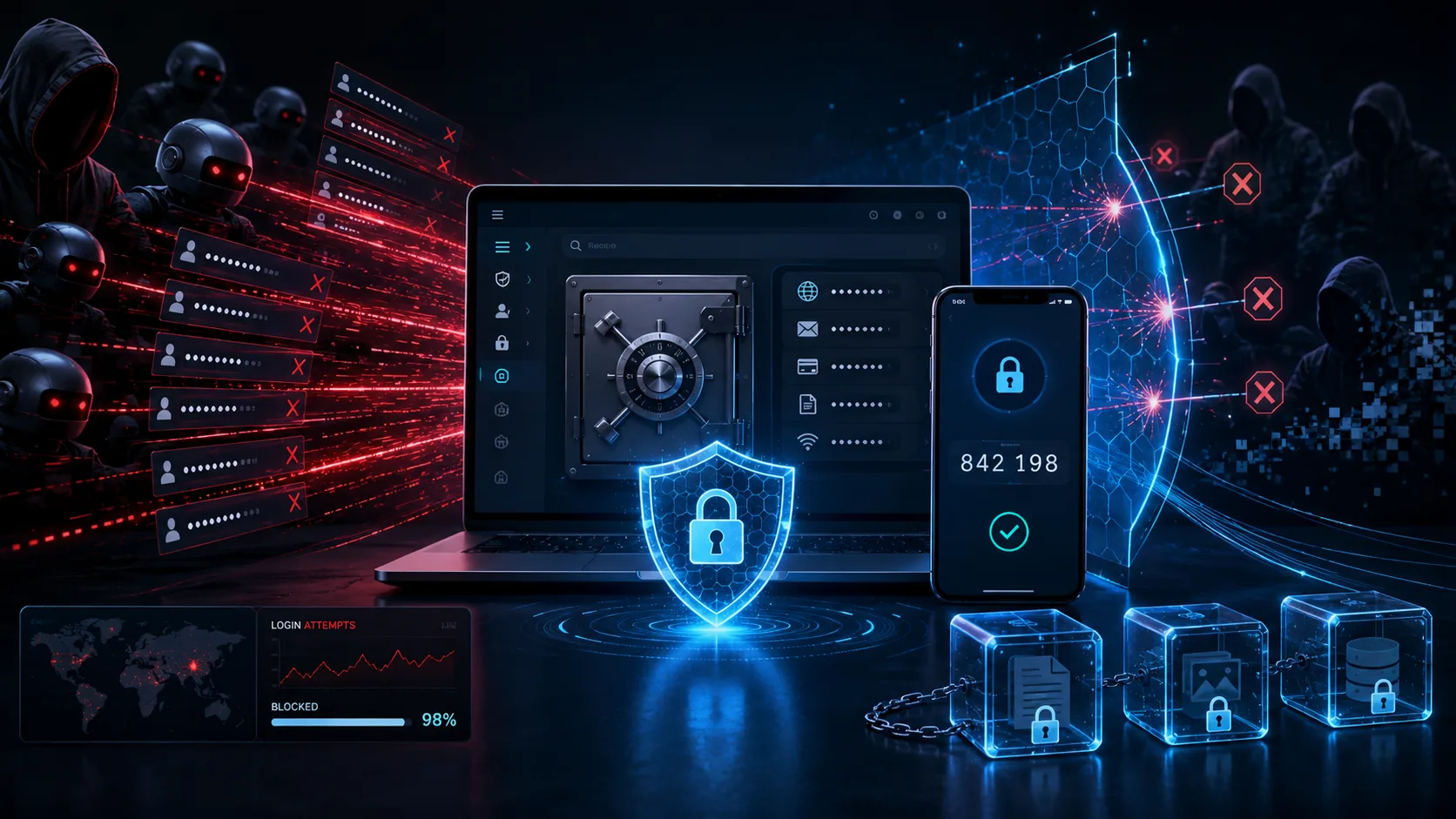
Dashlane confirmed that in late May 2026, selected user accounts were targeted by a brute force attack resulting in temporary access suspension and login issues. Despite the attack, user-stored data remained secure thanks to zero-knowledge architecture and end-to-end encryption. The incident is an important lesson for B2B organizations using enterprise password managers.
What We Know About the Incident
The attack involved mass login attempts using credential lists from previous data breaches (credential stuffing and brute force). Attackers tested email/password combinations on Dashlane accounts, betting on weak master passwords from users who do not use unique credentials for each service.
Dashlane implemented automatic account locks after detecting suspicious activity, causing temporary login problems for some users. The company emphasizes that password vaults—stored encrypted with a key derived from the user's master password—were not compromised. Zero-knowledge architecture means even the service operator has no access to decrypted data.
Why This Matters for B2B Organizations
- Password managers are targets – vault compromise gives access to all user credentials.
- Master password is the key – a weak master password undermines the entire security architecture.
- Credential stuffing works – users reusing passwords remain vulnerable despite vault encryption.
- MFA on manager account – an additional layer protects even if the master password leaks.
Best Practices for Organizations
Companies deploying enterprise password managers should enforce strong master password policy (min. 16 characters, uniqueness, no dictionary patterns), MFA on manager accounts, and regular audits of whether employees store passwords outside the vault. User training should explain that a password manager does not protect against a weak master password—the user must set it correctly.
Integration with SSO and IAM simplifies onboarding and offboarding: when an employee leaves, central vault access revocation is faster than manual password rotation across dozens of systems. Partners offering IT infrastructure services help design identity architecture combining password manager, MFA, and Conditional Access policies.
What to Do After a Vendor Incident
If your team uses Dashlane, verify access logs for organizational accounts, ensure MFA is enabled for all users, and consider master password rotation for accounts that may have been targeted. Even when the vendor confirms data safety, proactive hardening reduces risk in the next incident.
Organizations should have a procedure for assessing SaaS vendor incidents: who analyzes the vendor communication, when to escalate to leadership, whether integration key rotation is required. For password managers, understanding the trust model—zero-knowledge, hosted keys, or hybrid—and its compliance and audit implications is especially critical.
Broader Threat Context
The attack on Dashlane is not an isolated event. Password managers, identity providers, and cloud platforms regularly become targets of credential-based attacks. B2B organizations must treat these services as critical infrastructure—with monitoring, policy configuration backups, and migration plans to an alternative provider in case of long-term compromise.
Combined with EDR, phishing awareness, and network segmentation, an enterprise password manager remains one of the most effective means of reducing credential leak risk. The Dashlane incident confirms that product architecture can protect data—but only if users and organizational policies do their part. Deployment with IT infrastructure support ensures the tool is configured per best practices, not just installed on employee laptops.
Alternatives and Vendor Due Diligence
Enterprise password manager selection should be preceded by due diligence: security architecture audit, certifications (SOC 2, ISO 27001), incident history, and responsible vulnerability disclosure policy. Dashlane, 1Password, Bitwarden Enterprise, and KeePass with plugins have different trust models—the organization should choose one matching industry and regulatory requirements.
Continuity planning for password managers includes encrypted vault export in a secure location, migration procedure documentation to an alternative provider, and quarterly recovery tests. In a prolonged service unavailability scenario, the organization cannot afford blocked access to critical systems—offline backup and emergency procedures are the minimum, not an option.
Password Policy in B2B Organizations
Beyond enterprise password managers, organizations should implement NIST-aligned policy: minimum password length, leaked password deny lists, privileged password rotation, and account sharing prohibition. Dashlane and similar tools facilitate policy enforcement but do not replace HR processes for offboarding and audit procedures.
Regular phishing tests verifying whether employees use corporate passwords outside the vault provide an objective adoption picture. Test results should feed IT department KPIs and be discussed with leadership quarterly—not as a technical report, but as an operational risk indicator for the entire organization.
Source: Sekurak