

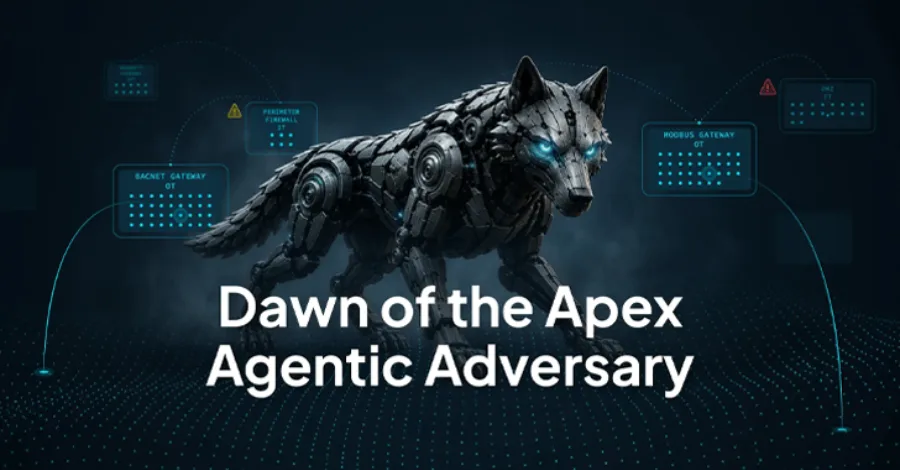
Cybersecurity experts describe the emerging "Apex Agentic Adversary" era—attackers using autonomous agentic AI systems for operations at speed and scale impossible for human teams. From vulnerability scanning through exploit generation to lateral movement and exfiltration—the entire chain can be automated and executed in minutes or hours while traditional SOCs respond in days. For B2B companies, this requires shifting from reactive defense to automated, proactive security strategy.
What Is an Agentic Adversary
Agentic AI systems based on language models and tool use plan multi-step tasks, make decisions, and execute actions without continuous human supervision. Offensively, an agent can: scan target infrastructure, identify CVEs, download PoCs, adapt exploits to the environment, escalate privileges, and exfiltrate data—all in a feedback loop. Defenders face asymmetry: one attacker operator with an AI agent can simultaneously attack hundreds of organizations.
This is not science fiction—early examples include reconnaissance automation, phishing generation, and CI/CD pipeline attack orchestration. Experts predict full chain autonomization within 12–24 months.
Response Speed Asymmetry
- Attack – minutes to hours from discovery to exploit.
- Traditional SOC – hours to days for triage and escalation.
- Patch management – days to weeks for test and patch deployment.
- Defense goal – seconds to minutes for automated response.
Proactive Defense Strategy
B2B companies must invest in SOAR (Security Orchestration, Automation and Response) with playbooks automatically responding to IoCs and behavioral anomalies. Patch management should prioritize KEV and actively exploited CVEs with SLAs measured in hours, not weeks. Attack surface management (ASM) and continuous exposure scanning reduce targets available to attacker agents.
Parallelly, organizations should explore defensive agentic AI—autonomous alert triage, automated threat hunting, and dynamic network segmentation. Through our AI solutions, we design architectures where AI supports SOC without replacing human oversight.
Zero Trust and Assume Breach
With machine-speed attacks, the "perimeter defense" model is dead. Zero Trust—verify every request, least privilege, micro-segmentation—limits impact even when an attacker agent gains foothold. Assume breach means continuous threat hunting and purple team exercises simulating autonomous attacks.
IT infrastructure must be designed with automatic kill switches: segment isolation, token revocation, IP blocking—triggered by SIEM/SOAR without waiting for analysts.
Regulation and Board Accountability
NIS2 and national cybersecurity law require management oversight of cyber risk. Boards must understand agentic AI threats shorten reaction time—and that lacking automated defense investment may result in personal manager liability. CISOs should present MTTD/MTTR metrics compared against machine-speed attack scenario benchmarks.
Tabletop Exercises for Agentic AI Scenarios
IR teams should conduct tabletop exercises simulating agentic AI attacks: mass vulnerability scanning within an hour, automated exploitation and exfiltration before SOC response. Scenarios reveal playbook and communication gaps—typically missing automatic segment isolation and reliance on manual escalation. Exercise results should feed SOAR and automation investment plans.
Cooperation with development teams is key—secure SDLC shortening patch-to-prod time directly limits attacker agent availability windows.
Budgeting Defense Against Agentic AI
CISOs planning 2027 budgets should include an "automation & agentic defense" line alongside traditional EDR/SIEM. SOAR, ASM, and managed threat hunting investment has measurable ROI: MTTR reduction, fewer ransomware escalations, lower breach costs. Board presentations in business language—"each hour of reduced reaction time lowers incident cost by X"—facilitates budget acceptance.
External security partner cooperation building SOAR runbooks accelerates time-to-value compared to internal projects from scratch.
Boards should receive quarterly "machine-speed readiness" reports covering: average MTTD/MTTR, percentage of alerts handled automatically by SOAR, critical CVE count remediated within <72h SLA, and latest purple team results. These metrics translate automation investments into business risk language understandable to non-technical management.
Partnership with AI and security providers enables testing defensive agentic AI use cases without building internal ML teams—faster time-to-value than internal R&D.
Establish internal SLAs: critical CVE in publicly exploited products—remediation within 48h, others—14 days. Agentic adversaries shorten these windows—without SLAs, patch management teams cannot keep pace with threat velocity.
Conclusion
The Apex Agentic Adversary era requires B2B companies to automate defense, adopt Zero Trust, and invest in SOAR. Reactive SOC is insufficient. We invite security strategy consultations through our IT services for businesses and AI solutions.
Source: The Hacker News – Dawn of the Apex Agentic Adversary