

The Accountability Problem in Asynchronous Systems
Auditing data changes in business applications is a requirement that appears in nearly every enterprise-grade project. Who modified a record? When? What data was changed? Every model-tracking tool answers these questions. The problem arises, however, when business logic is executed asynchronously – through queued jobs, scheduled tasks, or events emitted and handled in the background.
In such scenarios, standard audit mechanisms fail. A job has no access to the HTTP session that initiated the operation. The user who clicked a button in the interface is invisible in the context of the queue worker. The result? Logs full of entries with no author, or with the author set to "system" – information that tells you very little when you need to explain an incident or carry out a compliance audit.
Yammi Audit Log is a package that addresses this problem in an elegant, non-invasive way.
How Yammi Audit Log Works
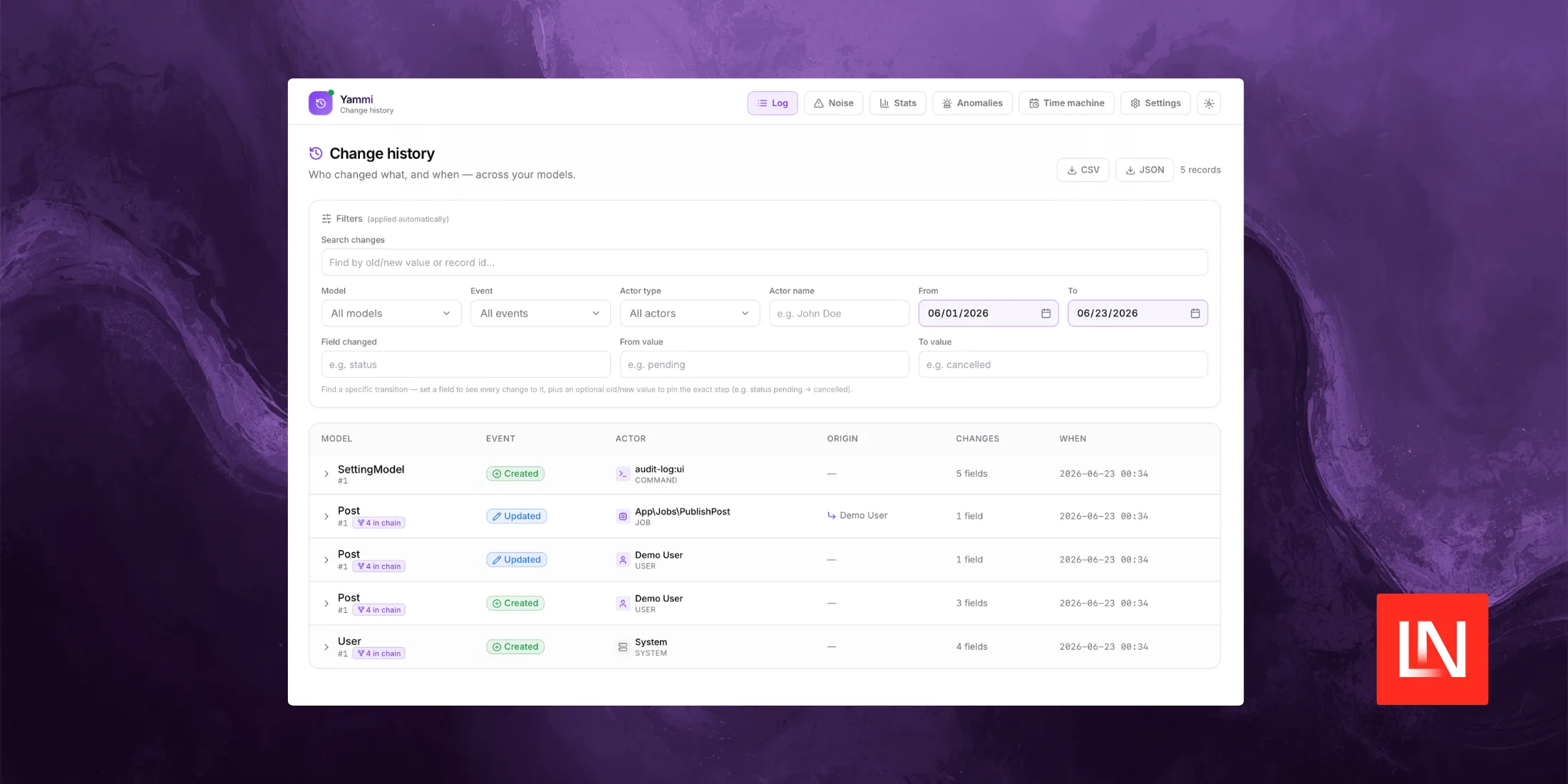
The foundation of the package is the correlation ID mechanism – a unique identifier created when an operation is initiated (for example, during an HTTP request) and propagated through the entire call chain, including queued jobs. When a job performs its work – updating records, creating new entities, dispatching further jobs – each of these operations is logged with the original user context that started the entire chain of events.
The package registers changes at the Eloquent model level, which means it does not require manually placing audit calls in business code. It is sufficient to add the appropriate trait to models that should be tracked and configure correlation ID propagation. Everything else happens automatically.
The audit record contains:
- The ID of the user who initiated the operation
- The correlation ID linking all related operations
- The model name and its identifier
- Previous and new values of changed fields
- A timestamp and context (HTTP vs. queue)
Business Scenarios – Where Yammi Audit Log Is Essential
Imagine an order management system in which a customer places an order through a web interface. That order triggers a series of queued jobs: warehouse stock reservation, invoice generation, notification dispatch, and status update in the ERP system. Each of these jobs modifies data – but which user is the author of those changes?
Without a proper audit mechanism, the answer is: unknown. With Yammi Audit Log, each of those operations is linked to the order initiated by a specific customer or employee, and the chain of changes can be traced from start to finish through the shared correlation ID.
Similar scenarios appear in financial systems (who approved a fund transfer?), HR systems (who modified employee data?), e-commerce platforms (who changed inventory status?), and any application with extensive background processing logic. In the context of custom software development for businesses, such requirements are the norm rather than the exception.
Importance for Regulatory Compliance and External Audits
Many industries operate in a regulatory environment that imposes specific requirements for recording data changes. GDPR requires demonstrating who processed personal data, and when. Sector-specific directives (finance, healthcare, public administration) often mandate detailed operation journals. External auditors and inspectors expect a complete change trail – and they are generally not interested in whether a change happened synchronously or through a queue.
Yammi Audit Log provides precisely this level of transparency. Audit data can be easily exported, filtered by user, model, or time range, and presented in the form of readable reports. It is a tool that directly enhances an organization's ability to demonstrate compliance – without the need to build a custom audit system from scratch.
Integration With Monitoring Infrastructure
Audit logs are a valuable source of information not only for compliance departments but also for engineering teams diagnosing incidents. When a production system exhibits an anomaly – an unexpected state change, a deleted record, a modified setting – an audit log with a correlation ID allows rapid reconstruction of the event sequence and identification of the problem source.
Data from Yammi Audit Log can be integrated with log centralization systems (ELK Stack, Grafana Loki, Datadog), enabling alert creation based on change patterns and construction of operational dashboards. Correctly configuring such an environment is an area in which we specialize through our IT infrastructure services.
Implementation and Recommendations for Teams
Introducing Yammi Audit Log into an existing Laravel project is relatively non-invasive. The package is installed via Composer, the migration creates an audit log table, and models requiring tracking receive the HasAuditLog trait. Correlation ID propagation through queues requires minimal configuration in job classes or through a global queue middleware.
We recommend implementing change auditing at an early stage of a project, when the integration cost is lowest, and the benefits of a complete change history grow alongside the system. Adding auditing to a mature, multi-year application is possible but requires more careful planning, especially regarding performance at high data volumes.
We invite you to explore our full range of IT services for businesses – we advise on tool selection and help implement engineering best practices in Laravel projects.
Conclusion
Yammi Audit Log solves one of the hardest problems in asynchronous systems: full change accountability regardless of whether a change happened synchronously or through a queue. The correlation ID mechanism, Eloquent model-level change recording, and straightforward integration with existing projects make it a valuable tool for every team that treats auditability as a system requirement rather than an add-on.
Source: Laravel News – Yammi Audit Log: Track Who Really Made a Change Across Jobs and Queues