

1. Market Context and Business Framework (Executive Summary)
For two decades, infostealer malware followed a predictable playbook: harvest credentials, cookies, and payment data, then dump the raw loot to a command-and-control server. A human operator would then manually decide whether a given victim was worth pursuing further – through spear-phishing, ransomware deployment, or selling access on darknet markets. That era is now over.
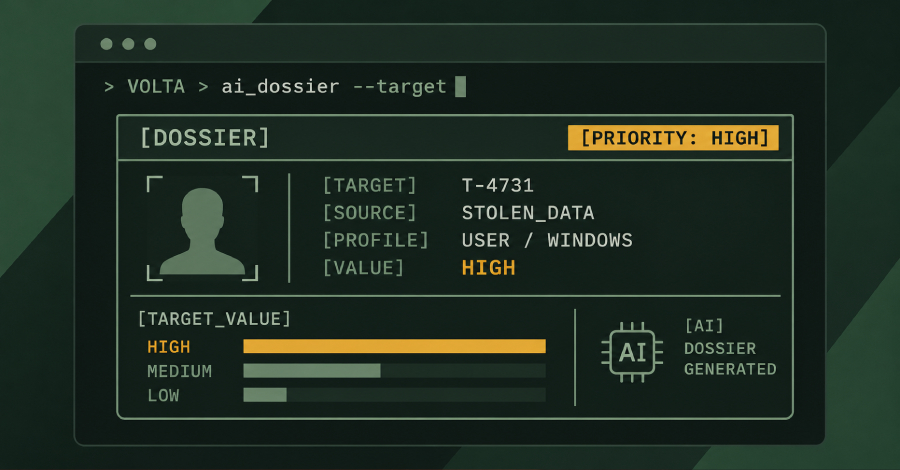
The discovery of VOLTA-AUTODOXER (VOLTA) by cybersecurity researchers represents a qualitative leap in the history of cybercrime. For the first time, a documented infostealer actively queries commercial large language models (LLMs) – including Anthropic Claude, Google Gemini, and Kimi AI – to automatically score and rank stolen data by its monetization potential. In plain terms: AI is now working on the attacker's side as a financial analyst and risk strategist.
For C-suite executives, SMB owners, and CTOs, this means one thing: the window between workstation compromise and actionable intelligence in the attacker's hands has collapsed from days to minutes. Before your IT administrator notices an anomaly in the logs, an algorithm has already assessed your company's financial profile, identified the most lucrative accounts, and queued further criminal actions with precision we have never seen before.
At AbejaIT, we have worked with businesses since 2003. We serve scrap metal dealers, coal depots, allotment garden associations, manufacturing companies, and trading firms. Each of these sectors stores data that VOLTA finds particularly attractive: bank account numbers, accounting records, ERP credentials, and warehouse management system logins. This article is not an academic threat survey – it is a practical engineering guide for those responsible for IT infrastructure security.
2. In-Depth Technical Analysis and Risk Vectors
2.1 How VOLTA Works – Attack Architecture
VOLTA is a Windows-based malware. The infection vector is conventional: most commonly a phishing email with an attachment masquerading as an invoice, delivery order, or procurement document. Once executed in user space, VOLTA systematically extracts data:
- Chromium-based browsers (Chrome, Edge, Brave, Opera) – saved passwords, session cookies, autofill history, and stored payment card data from SQLite databases in the user profile directory.
- Microsoft Outlook and mail profiles – PST/OST files, SMTP/IMAP credentials, S/MIME keys.
- Slack workspaces – session tokens, channel history, shared files.
- Password managers and cryptocurrency wallets – local KeePass databases, seed phrase files.
- Office documents – scans user directories for XLSX, DOCX, and PDF files containing financial keywords.
So far, this is standard infostealer behavior. The innovation appears in the next step: the collected data is structured into JSON format and transmitted over an encrypted HTTPS connection to an external API that queries one or more commercial LLM services. The prompt contains condensed victim metadata (account volumes, domain names, detected financial systems, available balances), and the model returns a financial score – a numeric rating and priority category: "High Value Target," "Medium," or "Low."
2.2 Why an LLM Scoring Module Is a Paradigm Shift
Traditional criminal tools used simple heuristic rules: if a password matches a banking domain, raise an alert. VOLTA introduces semantic contextual understanding. A language model can recognize that a login to an ERP system with a financial module is more valuable than 50 forum passwords. It understands that a file named "Q3_2025_financial_report.xlsx" has higher priority than "vacation_photos.zip." This is a fundamental qualitative change.
Furthermore, the distribution across Claude, Gemini, and Kimi suggests that VOLTA's operators employ API redundancy – if one provider blocks an API key, the malware switches to the next. This architecture is resilient to individual moderation blocks.
2.3 Risk Vectors for European SMBs
Based on our 23 years of engineering practice, we identify the following critical risk vectors typical of the SMB market:
- Endpoints without EDR – most companies in the scrap metal, coal depot, and allotment management segments rely on basic antivirus. VOLTA is designed to operate in user space without privilege escalation, making it difficult to detect with signature-based AV.
- Shared ERP logins – a single account shared among multiple employees is standard in SMBs. Compromising one password means full access to warehouse, invoicing, and accounts receivable modules.
- No MFA on critical systems – multi-factor authentication is still not standard outside banking and enterprise sectors.
- Exposed RDP sessions – Remote Desktop exposed on port 3389 without VPN remains alarmingly common in infrastructures we encounter during client onboardings.
- Flat network architecture – the accounting workstation on the same network segment as the file server, database server, and printer. VOLTA can laterally explore network resources.
3. Solution Architecture and Step-by-Step Implementation Guide
3.1 Defense-in-Depth Model
The response to VOLTA and similar AI-augmented threats must be multi-layered. No single control is sufficient. Below is the reference architecture we deploy at AbejaIT clients:
- Layer 0 – OS Hardening: CIS Benchmarks Level 2 for Windows 10/11 and Windows Server 2022, disabling unnecessary services, AppLocker or Windows Defender Application Control (WDAC).
- Layer 1 – EDR/XDR: Endpoint Detection and Response agent (e.g., CrowdStrike Falcon, Microsoft Defender for Endpoint, Elastic Security) with behavioral detection. VOLTA operating in user space will be detected through patterns of access to browser SQLite databases.
- Layer 2 – Zero Trust Network Access: VLAN segmentation, server network micro-segmentation, mandatory VPN with certificate for all remote access.
- Layer 3 – MFA Everywhere: TOTP or FIDO2 on every system – ERP, email, VPN, admin panels, no exceptions.
- Layer 4 – 3-2-1-1-0 Backup: 3 copies, 2 different media types, 1 offsite (cloud), 1 airgapped, 0 verification errors.
- Layer 5 – 24/7 Monitoring: SIEM with alert correlation, network anomaly detection, alerts on unauthorized LLM API calls from endpoints.
3.2 VOLTA Detection – Concrete Configuration
VOLTA's defining characteristic is calling an external LLM API from a workstation. We can detect this at the firewall and SIEM level. Example Suricata IDS rule:
alert http $HOME_NET any -> $EXTERNAL_NET any (
  msg:"VOLTA - Suspicious LLM API call from workstation";
  flow:established,to_server;
  http.uri;
  content:"/v1/messages"; nocase;
  http.header;
  content:"anthropic-version"; nocase;
  threshold: type limit, track by_src, count 1, seconds 60;
  classtype:trojan-activity;
  sid:9100001;
  rev:1;
)
Analogously for Google Gemini API:
alert http $HOME_NET any -> $EXTERNAL_NET any (
  msg:"VOLTA - Suspicious Gemini API call from workstation";
  flow:established,to_server;
  http.uri;
  content:"generativelanguage.googleapis.com"; nocase;
  threshold: type limit, track by_src, count 1, seconds 60;
  classtype:trojan-activity;
  sid:9100002;
  rev:1;
)
At the Windows Event Log level, monitor process access to browser profile directories:
# PowerShell – detect access to Chrome Login Data by unknown process
Get-WinEvent -FilterHashtable @{
  LogName='Security';
  Id=4663
} | Where-Object {
  $_.Message -match "Login Data" -and
  $_.Message -notmatch "chrome.exe|msedge.exe|brave.exe"
} | Select-Object TimeCreated, Message | Export-Csv c:\audit\chromium_access.csv
3.3 Backup and Disaster Recovery
Even with effective detection, we assume the worst-case compromise scenario. The 3-2-1-1-0 backup rule is the foundation:
# Restic backup to S3-compatible storage (e.g., Backblaze B2)
restic -r s3:s3.us-west-004.backblazeb2.com/company-backup \
  --password-file /etc/restic/passwd \
  backup /var/www /var/lib/postgresql /etc \
  --exclude-file /etc/restic/excludes.txt \
  --tag "daily" \
  --verbose

# Integrity check (run weekly!)
restic -r s3:s3.us-west-004.backblazeb2.com/company-backup \
  --password-file /etc/restic/passwd \
  check --read-data-subset=10%
Disaster Recovery restore tests must be conducted quarterly – not just verifying backup integrity, but actually restoring the environment on an isolated host and measuring RTO (Recovery Time Objective).
4. Engineering Implementation and Audit Checklist
- [ ] OS Hardening applied: CIS Benchmark Level 1 (minimum) or Level 2 on all workstations and servers. Disable SMBv1, enforce NTLMv2, enable Windows Defender Credential Guard.
- [ ] EDR deployed and active: Confirm the EDR agent is running on 100% of endpoints – not 95%. Every uncovered host is a potential patient zero.
- [ ] MFA on all critical systems: ERP, email, VPN, RDP, hosting panels – no exceptions.
- [ ] No RDP exposed to the internet: Remote access exclusively via certificate-based VPN. Port 3389 blocked on perimeter firewalls.
- [ ] VLAN network segmentation: Separate VLANs for workstations, servers, printers, IoT/weighbridges, and guest networks.
- [ ] Firewall rules blocking LLM API calls from corporate network: Block outbound connections to api.anthropic.com, generativelanguage.googleapis.com, api.moonshot.cn at Layer 7 firewalls.
- [ ] 3-2-1-1-0 Backup with DR test: Documented and tested recovery plan. Last DR test no older than 90 days.
- [ ] SIEM with anomaly detection: Alerts for unauthorized access to browser profile directories, mass SQLite file reads, external API calls from workstation endpoints.
- [ ] Privileged Access Management (PAM): Every administrator has a separate daily-use account (without local admin rights) and a separate administrative account used exclusively through PAM (e.g., CyberArk, Delinea, BeyondTrust, or open-source Teleport).
- [ ] Anti-phishing training: At least 2 simulated phishing tests per year, results documented, susceptible employees directed to mandatory training.
- [ ] Asset inventory: Up-to-date registry of all hosts, services, and ports – CMDB synchronized with reality (e.g., via weekly Nmap scan or Netbox).
- [ ] Password policy and corporate password manager: Bitwarden Teams or 1Password Business deployed for all employees. No password reuse across systems.
5. Legal, Tax, and Regulatory Compliance Requirements
5.1 NIS2 Directive – Obligations Since 2024
The NIS2 Directive imposes on essential and important entities (including companies in manufacturing, energy distribution, and waste management) the obligation to:
- Implement cybersecurity risk management measures (Article 21 NIS2).
- Report incidents to CSIRT within 24 hours of detection (initial notification) and 72 hours (detailed report).
- Conduct regular security audits.
- Face fines up to €10 million or 2% of global turnover for essential entities.
5.2 GDPR and Personal Data Protection
VOLTA steals session cookies and profile data – including personal data of customers and employees stored in CRM and ERP systems. Any such compromise constitutes a personal data breach under Article 4(12) GDPR, which must be reported to the supervisory authority within 72 hours. Fines for failure to report can reach €10 million or 2% of annual turnover.
5.3 DORA Regulation for the Financial Sector
Companies linked to the financial sector (factoring, leasing, lending) have been subject to the DORA (Digital Operational Resilience Act) regulation since 2025, which requires TLPT penetration tests and ICT incident reporting. A VOLTA compromise scenario must be included in the operational resilience plan.
5.4 Sector-Specific Context – Scrap Metal and Coal Depots
For companies using systems such as ESSW (zlom.io) or wegiel.io, an additional risk is the compromise of credentials providing access to waste management registry systems or coal product records. Unauthorized access to such systems can lead to manipulation of transport documents and serious regulatory sanctions. Similarly, access to coal excise duty documentation systems carries the risk of forging declarations, resulting in criminal tax liability.
6. Total Cost of Ownership (TCO) vs Return on Investment (ROI)
6.1 Cost of an Incident – Real Numbers
Based on IBM's Cost of a Data Breach Report 2024 and our own observations with clients, we estimate the cost of a VOLTA-class infostealer incident for a European SMB:
- Operational downtime: 2–7 days without a DR plan = €5,000–€35,000 in lost revenue (depending on sector and company size).
- IT environment restoration costs: €4,000–€20,000 (reinstallation, data recovery, testing).
- GDPR supervisory authority fines for failure to report: from €1,000 to hundreds of thousands of euros.
- NIS2 fines: potentially millions of euros for essential entities.
- Reputation damage: difficult to quantify, but Ponemon research indicates 30–40% of customers leave a vendor after a serious security incident.
- Ransomware ransom (VOLTA may be a precursor reconnaissance vector): the median ransom for SMBs in 2024 was approximately $200,000.
Estimated total incident cost: €12,000–€120,000+ for a typical SMB.
6.2 Cost of Prevention
A complete security stack for a company with 20–50 employees:
- EDR (Microsoft Defender for Endpoint Plan 2): ~$15/user/month = ~€9,000–€22,500/year.
- Cloud backup (Backblaze B2 + Restic): ~€150–€600/year.
- NGFW firewall (e.g., FortiGate 60F or pfSense + Snort): ~€1,200–€3,500 (CAPEX) + ~€700/year signature subscription.
- Anti-phishing training (KnowBe4 or Proofpoint Security Awareness): ~€1,200–€2,500/year.
- Audit and 24/7 monitoring by AbejaIT: individually scoped.
Total prevention cost: ~€12,000–€30,000/year.
ROI on cybersecurity investment, with an estimated 20–30% annual incident probability for an unprotected SMB: the benefit-to-cost ratio ranges from 3:1 to 10:1. This is one of the best investments a management board can make in 2025.
7. Frequently Asked Questions (FAQ)
Is my company too small to be targeted by VOLTA?
This is one of the most common and most dangerous myths. VOLTA does not select targets manually – the AI scoring happens automatically and at massive scale. Small companies are often more attractive than large corporations precisely because they have weaker defenses while still holding real financial assets: corporate bank accounts, access to banking systems, and customer data. Scrap metal dealers, coal depot operators, and allotment garden associations are ideal targets – they handle cash transactions, maintain bank account access, and rarely have a dedicated security team.
Is standard antivirus sufficient to protect against VOLTA?
No. VOLTA is designed to operate in user space without system privilege escalation and without persistently writing malicious files to disk (fileless techniques or LOLBins – Living Off the Land Binaries). Traditional signature-based antivirus has very limited effectiveness against such threats. What is required is behavioral detection at the EDR level, which monitors file access patterns, system API calls, and network traffic in real time. Windows Defender alone, without a Defender for Endpoint license, does not provide sufficient visibility.
How quickly can VOLTA exfiltrate data and deliver it to the attacker?
Data extraction from a typical workstation takes seconds to a few minutes. Browser SQLite databases are copied immediately. LLM API scoring takes additional seconds. The entire cycle – from malware execution to a complete victim profile in the attacker's hands – can take less than 5 minutes. Without real-time monitoring, an IT administrator may learn about the incident days or weeks later – long after the data has been sold or weaponized.
What should I do in the first hours after detecting a VOLTA infection?
Your incident response (IR) procedure must be documented and rehearsed. Key steps: (1) Immediately isolate the infected workstation from the network – disconnect from LAN and WiFi (do not power off the machine – preserve RAM for forensic analysis). (2) Change all passwords from a clean, uncompromised device – prioritize: bank accounts, ERP, corporate email, VPN, hosting panels. (3) Invalidate all active sessions in cloud systems. (4) Report the incident to the appropriate national CSIRT if critical infrastructure is involved. (5) Assess the scope of personal data exposure and if necessary, report the breach to the supervisory authority within 72 hours. (6) Contact the AbejaIT engineering team for forensic support and infrastructure recovery.
8. Dedicated Solutions and Deployment in the AbejaIT Ecosystem
At AbejaIT, we have designed and maintained IT infrastructure for businesses that cannot afford downtime for over 23 years. Our approach to cybersecurity is built into every product and every service – it is not an optional add-on.
For companies using the ESSW (zlom.io) system for scrap metal and secondary raw material procurement, we offer deployment environment hardening: weighbridge network isolation, encrypted connections to waste registry systems, MFA on operator panels, and automated PostgreSQL database backups with 90-day retention.
Users of the wegiel.io platform for coal and fuel depots receive an environment with encrypted SSL/TLS connections, separation of coal product records data, and a full audit log of every operation – critical for both security and excise duty control requirements.
The mojafirma.io ERP system with e-invoicing integration operates on a cloud architecture with full encryption, geo-redundant backups, and 24/7 availability monitoring. Every access to the financial module requires MFA – this is a mandatory requirement, not an option.
The dzialkowiec.io platform for family allotment gardens protects allotment holders' personal data in full GDPR compliance, with a complete processing log and the ability to export data upon data subject request.
If you want to conduct a security audit of your infrastructure, deploy EDR, configure 24/7 monitoring, or develop a Disaster Recovery plan – we invite you to explore our IT infrastructure services or schedule a direct consultation with our engineering team.
VOLTA is not a future threat. It is a present one. The AI models that help us work more efficiently every day are already being actively exploited by cybercriminals to automatically score and prioritize victims. Companies that invest in multi-layered protection today will not be paying million-dollar incident costs tomorrow.
Source reference: The Hacker News